
English


QQ:1195537948
Tel:400-167-8986
Email:order@genenode.com
Web:www.genenode.com
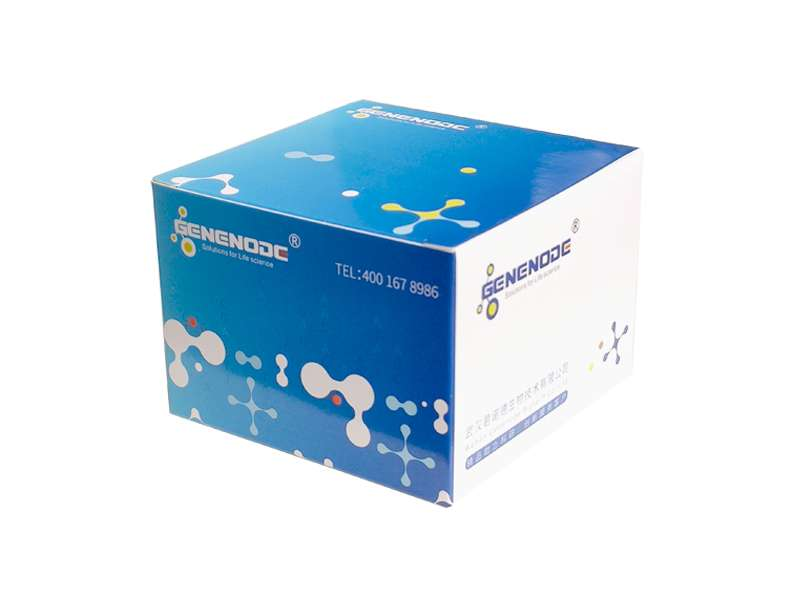
Bacteria gDNA Isolation Kit(Solution)
Number:D2513
Specifications:50T/100T/200T
Price:240/430/820
Package:box
Storage:4℃
Bacteria gDNA Isolation Kit(Solution)
Packing Specification:
| D2513-50 | Bacteria gDNA Isolation Kit(Solution) | 50T | CNY240 |
| D2513-100 | Bacteria gDNA Isolation Kit(Solution) | 100T | CNY430 |
| D2513-200 | Bacteria gDNA Isolation Kit(Solution) | 200T | CNY820 |
Product Introduction:
This kit is used for the rapid extraction of genomic DNA from various bacteria. After adding Nucleus Lysis Buffer to bacterial samples (or lysing the cell wall with lysozyme or other enzymes), cells are first lysed to release genomic DNA under the action of strong detergents. Then RNase A is added to remove RNA, followed by selective precipitation of proteins with Protein Precipitation Buffer. Finally, pure genomic DNA is precipitated with isopropanol and redissolved in DNA Dissolution Buffer.
Product Features:
1.No need for toxic reagents such as phenol.
2.Fast and simple; operation for a single sample can generally be completed within 30 minutes.
3.Stable results and high yield. The typical OD260/OD280 ratio is 1.7-1.9, and the DNA length can reach 50 kb - 150 kb. It can be directly used for library construction, PCR, Southern blot, and various restriction enzyme digestion reactions.
Application Scope:
Suitable for the rapid extraction of genomic DNA from various bacteria.
Operation Steps:
1.Collect 1 mL of overnight cultured bacteria into a 1.5 mL centrifuge tube.
2.Centrifuge at 9,000 rpm for 30 seconds to pellet the cells. Discard the supernatant, then vortex or tap gently to disperse the cell pellet. For Gram-positive bacteria, proceed to Step 3. For Gram-negative bacteria, skip directly to Step 6.
3.Add 480 μL of 50 mM EDTA to fully resuspend the cells.
4.Add 120 μL of Lysozyme (20 mg/mL in 10 mM Tris-HCl, pH 8.0) and mix well.
Lysozyme is effective for lysing most Gram-positive bacteria such as Bacillus subtilis, Micrococcus luteus, Arthrobacter luteus, Nocardia otitidiscaviarum, Rhodococcus rhodochrous, and Brevibacterium albidium. However, for certain Staphylococcus species, add 60 μL of Lysozyme (20 mg/mL) and 60 μL of lysostaphin (20 mg/mL) to ensure effective lysis.
5.Incubate at 37℃ for 30-60 minutes. Centrifuge at 12,000 rpm for 2 minutes, discard the supernatant, then vortex or tap gently to disperse the cell pellet.
6.Add 600 μL of Nucleus Lysis Buffer to the dispersed cells and gently pipette to lyse the cells.
7.Incubate at 80℃ for 5 minutes to lyse the cells, then cool to room temperature.
8.Add 1.8 μL of RNase A (10 mg/mL) to the lysate to a final concentration of 30 μg/mL. Invert to mix, then incubate at 37℃ for 15-60 minutes to remove residual RNA. Cool to room temperature for at least 5 minutes.
9.Add 200 μL of Protein Precipitation Buffer to the room temperature lysate, then vortex continuously at high speed for 25 seconds. Small protein clumps may be visible after mixing. Incubate on ice for 5 minutes.
Due to the small sample volume and weight, the shearing force generated by vortex mixing will not shear genomic DNA. If mixing by hand, do not shake vigorously up and down—only mix with moderate force to avoid shearing DNA. However, the force must be sufficient to ensure thorough mixing and dispersion of the viscous lysate; otherwise, DNA cannot be separated from protein precipitates and will precipitate with proteins during centrifugation, causing DNA loss or reduced yield. Inadequate mixing may also result in incomplete protein precipitation, leading to significant protein contamination in the final product. Therefore, vortex mixing is recommended.
10.Centrifuge at 13,000 rpm for 5 minutes. A white protein pellet should be visible at the bottom of the tube, and some protein precipitate may also float on the liquid surface.
11.Carefully aspirate the supernatant into a new 1.5 mL centrifuge tube.
Avoid aspirating the protein pellet at the bottom or floating on the surface. If protein precipitate is accidentally transferred to the new tube, centrifuge again for 2 minutes and collect the supernatant.
12.Add an equal volume (approximately 600 μL) of room temperature isopropanol, gently invert 30 times to mix until flocculent (filamentous) white DNA precipitate appears.
During inversion mixing, flocculent (filamentous) DNA may sometimes adhere to the lid or tube mouth and not dislodge, leading the operator to fail to see the precipitate and mistakenly assume no DNA was obtained. Solution: Omit Step 13, centrifuge directly at 12,000 rpm for 1 minute, discard the supernatant, then proceed to Step 15.
13.Place the centrifuge tube vertically to allow the white DNA precipitate to settle naturally to the bottom. Aspirate and discard as much supernatant as possible, taking care not to aspirate the precipitate.
14.Add 1 mL of 70% ethanol, invert to wash the DNA precipitate, then centrifuge at 12,000 rpm for 1 minute. A white DNA pellet will be visible at the bottom of the tube. Discard the supernatant.
15.Add 0.5 mL of 70% ethanol, invert several times to wash the DNA precipitate, then centrifuge at 12,000 rpm for 1 minute. Discard the supernatant (be careful not to discard the DNA pellet). Invert the tube and tap gently on absorbent paper to drain residual ethanol, or carefully aspirate residual ethanol around the pellet and tube wall with a pipette tip. Air-dry the pellet for a few minutes.
Avoid over-drying (DNA will be extremely difficult to dissolve) or leaving excessive residual ethanol (which may inhibit downstream reactions such as enzyme digestion).
16.Add 100 μL of DNA Dissolution Buffer to rehydrate and dissolve the DNA pellet. Tap the tube wall to mix. Incubate at 65℃ for 30-60 minutes (no more than 1 hour), tapping the tube wall occasionally to assist hydration. Alternatively, allow hydration at room temperature or 4℃ overnight, inverting and tapping occasionally to aid dissolution.
17.Store DNA at 2-8℃ for short-term use or -20℃ for long-term storage.


Official wechat
Contact number
18518676727
Instant messaging
QQ:800176181/1195537948
order@genenode.com
Address
C5-1, Zone C, Yangluo Port Huazhong International Industrial Park, No. 99, Yubo North Road, Yangtze River New Area, Wuhan City, Hubei Province
©2011-2025 IBAC 主营业务:RNA pull down DNA pull down GST pull down CoIP LC-MS/MS TAP-MS 抗体测序 版权所有